



Unintentional weight loss is weight loss without dieting, exercise, or lifestyle changes. It can affect adults of any age, but the risk rises after 40.
Unintentional weight loss—medically defined as losing 5% or more within 6–12 months, especially with fatigue, appetite changes, or pain. —is one of the earliest red flags the body raises when something is deeply wrong. (Source)
When does “losing weight naturally” stop being normal and start becoming a cancer warning sign?
Your mother mentions she’s “just not hungry anymore,” or your father’s pants are loose, but he shrugs it off because he is ‘finally losing that belly.’
Then one day, someone says the word no one wants to hear: cancer. And suddenly, all those dismissed pounds feel like missed warnings.
In this world, where we celebrate weight loss like a victory, this symptom is dangerously normalised. But here’s what many don’t realise: unexplained weight loss is the presenting symptom in nearly 40% of cancer diagnoses, particularly in gastrointestinal, lung, and blood cancers.
If someone in your family is losing weight without dieting or exercising more, it’s not always a blessing. Sometimes, it’s the body’s distress signal—and recognising it early can be the difference between Stage I intervention and Stage IV regret.
The reassuring news is that early help is available through Joydeep Ghosh, an experienced cancer doctor in Kolkata. He can help identify causes early and guide the next steps with clarity!
Why does unexplained weight loss feel “normal” until it isn’t?
Kolkata’s relationship with health is complicated. We wait. We rationalise. We juggle work commutes and family life. Then, from obligations to festival preparations, we tell ourselves, “We’ll do it later.” Meanwhile, the body keeps signalling.
But when weight loss is unintentional, when it happens despite normal eating habits or even increased hunger, and when it’s accompanied by fatigue that rest doesn’t fix or discomfort that antacids don’t touch—it’s no longer a lifestyle. It’s pathology.
But cancer-related weight loss isn’t about willpower. It’s driven by inflammation, altered metabolism, and reduced intake—often before pain appears. That’s why the body whispers first.
.
How common is this, really—and why care now?
Late-stage diagnosis remains common, and weight loss is a frequent early clue. Urban routines delay care: work deadlines, traffic, and procrastination. The cost of waiting isn’t fear—it’s lost time.
Which cancers most often show weight loss early?
| Cancer Type | Why Weight Loss Occurs | Other Early Signs Often Missed |
| Pancreatic Cancer | Blocks digestive enzyme release; fat and protein aren’t absorbed properly | Upper abdominal pain radiating to the back, new-onset diabetes, jaundice |
| Stomach Cancer | Causes early satiety and appetite suppression | Persistent indigestion, nausea, vomiting after meals, black stools |
| Lung Cancer | Raises metabolic demand and releases appetite-suppressing cytokines | Chronic cough, chest pain, breathlessness, blood in sputum |
| Colon Cancer | Chronic blood loss and impaired nutrient absorption | Change in bowel habits, blood in stool, cramping, unexplained anemia |
| Lymphoma | Systemic inflammation increases calorie burn | Painless swollen lymph nodes (neck, armpit, groin), night sweats, itching |
| Blood Cancers (Leukemia & Myeloma) | Bone marrow failure and chronic inflammation drain energy stores | Frequent infections, persistent fatigue, easy bruising, bone pain |
| Advanced Prostate & Head-and-Neck Cancers | Cancer-related cachexia and difficulty eating or swallowing | Urinary changes (prostate), hoarseness, mouth sores, difficulty swallowing, neck lumps |
The earlier these cancers are caught, the more treatment options exist. But the window is narrow, and it begins with noticing what others miss.
What separates harmless weight changes from warning signs?
Not all weight loss is dangerous. The context matters.
Weight loss—when to watch vs when to act
| Situation | Likely Explanation | What to Do |
| Small dip during illness | Temporary | Monitor |
| Gradual loss with appetite loss | Possible metabolic cause | Test |
| Rapid loss with fatigue | Systemic illness | Evaluate |
| Loss + pain/bleeding | Red flag | Act now |
What’s actually happening inside the body during cancer-related weight loss?
Cancer can trigger cachexia—a state where inflammation accelerates muscle breakdown and blunts appetite. Calories alone don’t fix it. Early detection does.
How should diagnosis proceed—without panic or delay?
A calm, stepwise approach saves time.
The right diagnostic pathway
The process isn’t as terrifying as feared. Dr. Joydeep Ghosh, a cancer doctor in Kolkata, will typically proceed with these steps during an evaluation.
| Diagnostic Step | What It Reveals | Timeframe |
| Detailed History & Physical Exam | Identifies symptom patterns, risk factors, palpable masses | Same day |
| Blood Tests | Detects anaemia, liver function issues, and elevated cancer markers | 1–2 days |
| Imaging (Ultrasound, CT, MRI, PET scan) | Locates tumours, assesses organ involvement, and checks for metastasis | 3–7 days |
| Endoscopy / Colonoscopy (if GI symptoms present) | Directly visualises the stomach, colon, or oesophagus; allows biopsy | Same week |
| Biopsy | Confirms cancer type, grade, and guides treatment planning | 5–7 days for pathology report |
If it is cancer, what treatments work—and when?
Outcomes improve dramatically when treatment starts early. Options depend on cancer type and stage, and may include chemotherapy, targeted therapy, or immunotherapy—used thoughtfully, not blindly.
Patients often seek a cancer doctor in Kolkata to coordinate care across disciplines.
Treatment choices—why timing changes outcomes
| Approach | Best Used When | Goal |
| Chemotherapy | Systemic disease | Control/eradicate |
| Targeted therapy | Known mutations | Precision |
| Immunotherapy | Immune-responsive cancers | Durable response |
| Combined care | Many scenarios | Best balance |
Remember, when searching for a chemotherapy doctor in Kolkata or an immunotherapy doctor in Kolkata, the key is choosing the right approach, not just a new one.
Why do delays cost more than people expect?
Because disease biology doesn’t pause. Waiting can mean:
- Fewer effective options
- Longer treatment duration
- Higher physical and emotional toll
Delay vs consequence
 How does local lifestyle quietly shape risk?
Late dinners, irregular meals, smoking exposure, and chronic stress compound risk. Add family history—and the signal strengthens. That’s why early conversations matter.
Act now if weight loss comes with
- Night pain or persistent cough
- New swallowing difficulty
- Ongoing bowel changes
- Unexplained bleeding
Early-stage cancers are often treatable with surgery, targeted therapy, or localised radiation—minimally invasive, highly effective.
Advanced cancers require chemotherapy, immunotherapy, or precision oncology approaches, which are more intensive but still offer meaningful outcomes when started promptly. What is the difference between these two scenarios? Weeks. Sometimes just days.
Why Precision Matters in Cancer Care
Not all cancers behave the same way, even within the same organ. A stomach cancer in one patient may respond beautifully to chemotherapy, while another patient’s tumour may require targeted therapy based on specific genetic mutations.
This is where precision oncology—an approach championed by Dr Joydeep Ghosh, a leading cancer doctor in Kolkata—becomes critical.
Precision oncology involves genomic profiling of the tumour to identify molecular targets, then tailoring treatment accordingly. It’s the difference between a one-size-fits-all protocol and a personalised strategy that is effective while minimising unnecessary side effects.
For families in Kolkata navigating cancer care, this approach offers hope grounded in science rather than just statistics.
The Real Cost of Waiting
Here’s the truth no one wants to say out loud: every month you wait, the cancer doesn’t. It grows. It spreads.
Why does it become harder to treat
- A Stage I pancreatic cancer has a five-year survival rate of around 40–50% with surgery.
- A Stage IV? Less than 3%.
(Source)
The difference between those stages isn’t always years—it’s often months.
What You Can Do Right Now
If you’re reading this at night, worried about yourself or someone you love, read this carefully.
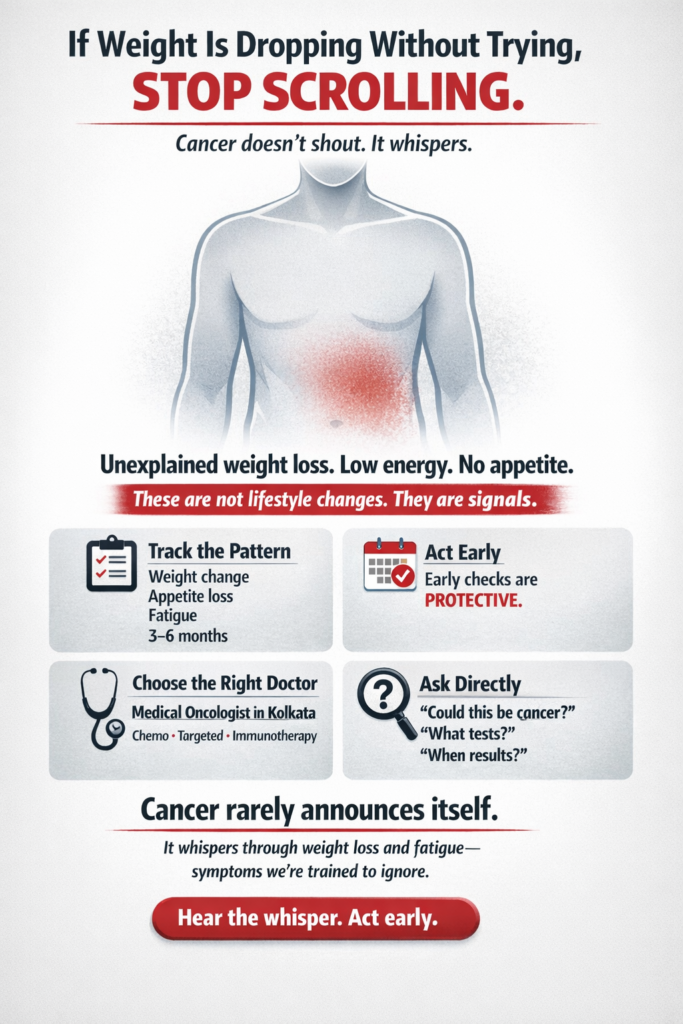
Book an early consultation today with Dr Joydeep Ghosh, a leading cancer doctor in Kolkata.
People Also Ask
Can stress alone cause sudden weight loss?
Short-term stress may reduce appetite, but persistent weight loss needs medical evaluation to rule out underlying disease.
Is cancer-related weight loss reversible?
Yes—when detected early and treated correctly, weight and strength can often be regained.
How fast is “too fast” when losing weight unintentionally?
Losing more than 2–3 kg in a few months without trying is medically significant.
Are normal blood tests enough to rule out cancer?
No. Blood tests can appear normal even when cancer is present; imaging and biopsy matter.
Should elderly weight loss always be investigated?
Absolutely. Age-related weight loss should never be assumed to be “normal.”