


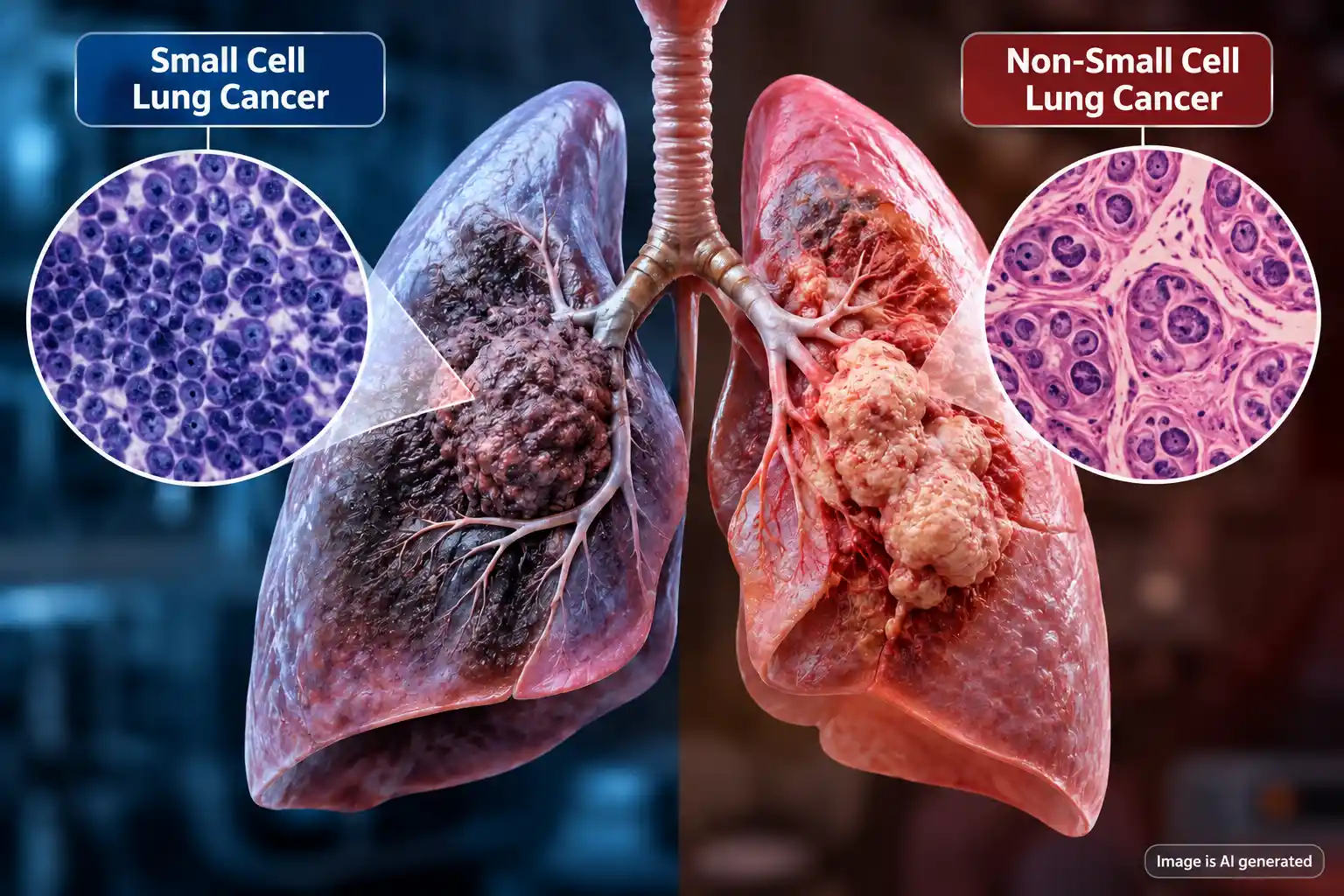
Hearing the words “lung cancer” can be overwhelming for patients and their families. Learning that the diagnosis is small cell or non-small cell may raise further questions. These two types differ in how quickly they grow, how they spread, and how they respond to treatment.
This guide explains the key differences, how doctors diagnose each type, and how stage and biomarker testing influence treatment decisions.
Why Does the Type of Lung Cancer Matter?
Mainly because lung cancer is not a single disease, but a collection of different malignancy types. Doctors categorise them into two main groups based entirely on how the cells look under a microscope.
- Non-small cell lung cancer (NSCLC)
- And Small cell lung cancer (SCLC)
Identifying the exact type is critical because it dictates how the disease behaves and is managed. The specific type influences how fast the disease grows, its likelihood to spread, the choice of treatment options, and the schedule for follow-up care.
As symptoms and imaging scans cannot distinguish between these types, a patient must undergo a tissue biopsy to confirm the exact diagnosis before starting a targeted treatment plan.
What Is Non-Small Cell Lung Cancer (N-SCLC)?
A general term for any epithelial lung malignancy that is not small cell lung carcinoma. It accounts for about 80% to 85% of all lung malignancy cases. [Source].
What Are the Main Subtypes?
- Adenocarcinoma: Develops in mucus-producing glandular cells, usually in the outer lung. It is the most common subtype and frequently occurs in non-smokers and women.
- Squamous Cell Carcinoma: Begins in flat cells lining the airways, particularly the bronchi. It is strongly linked to smoking.
- Large Cell Carcinoma: An undifferentiated subtype that can develop anywhere in the lung and often grows rapidly.
- Other Subtypes: Include rare forms such as adenosquamous and sarcomatoid carcinomas.
Note: NSCLC often grows more slowly than SCLC, although its behaviour varies by subtype and individual case.
What Is Small Cell Lung Cancer (SCLC)?
An aggressive form of tumour that forms in lung tissue. It is characterised by small, oval-shaped cells under a microscope.
SCLC is less common than NSCLC, accounting for about 10% to 15% of all lung malignancy cases. [Source].
This type of malignancy is strongly linked to cigarette smoking and is exceptionally rare in people who have never smoked. SCLC is notorious for growing rapidly and spreading (metastasising) to other parts of the body very early in the disease.
As its early symptoms—like a persistent cough or shortness of breath—are easy to miss or dismiss as everyday issues, the disease is usually diagnosed after it has already spread.
Doctors typically categorise it using a simple two-stage system:
- Limited stage: The malignancy is found on only one side of the chest and can be treated with a single radiation field.
- Extensive stage: The disease has spread widely throughout the lung, to the other lung, or to distant parts of the body.
What Are the Key Differences Between the Two?
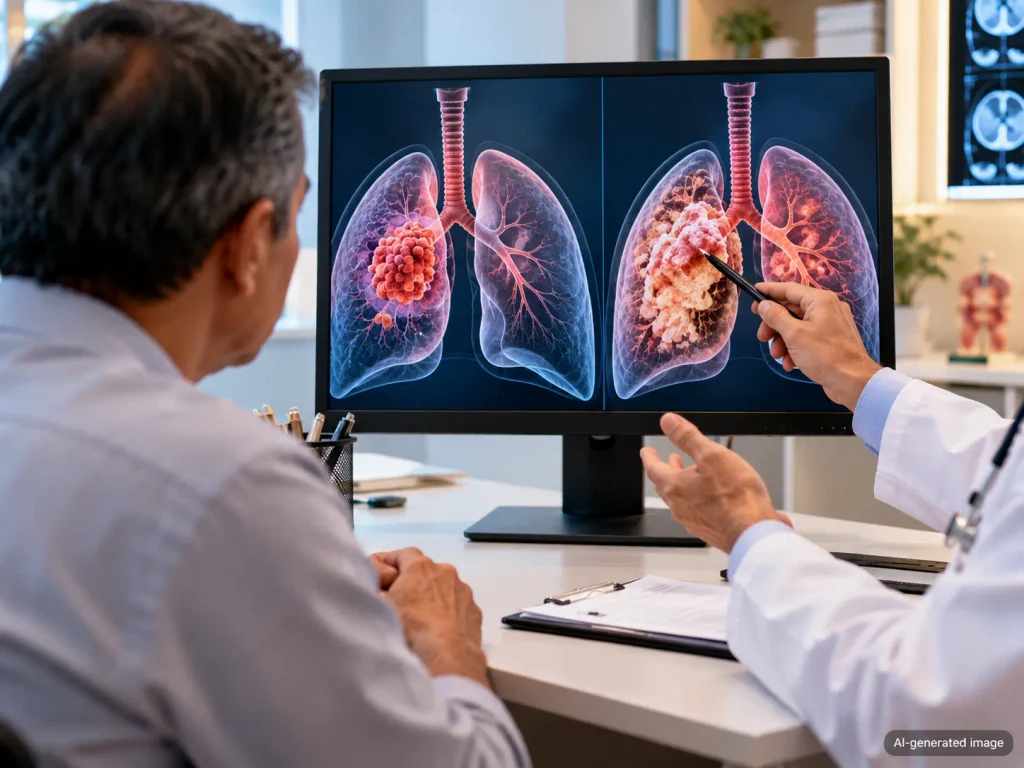
They differ in their frequency, growth rate, spread, staging, and treatment approaches.
| Feature | Small Cell | Non-Small Cell |
| Prevalence | About 10%–15% of cases | About 80%–85% of cases |
| Subtypes | Small cell carcinoma, combined small cell carcinoma | Adenocarcinoma, squamous cell carcinoma, large cell carcinoma |
| Link to Smoking | Very strongly associated with smoking | Associated with smoking but also occurs in non-smokers |
| Growth Speed | Typically grows rapidly | Growth rates vary by subtype |
| Spread | Often spreads early to distant organs | Spread patterns and rates vary by subtype |
| Staging | Limited-stage or extensive-stage | Stages I through IV |
| Main Treatment | Primarily chemotherapy and radiation therapy | Surgery, radiation, chemotherapy, targeted therapy, and immunotherapy |
Ultimately, SCLC typically grows rapidly and spreads early, making systemic treatments central to its management. NSCLC varies more in its behaviour and may be treated with surgery when detected early, alongside other treatments depending on its subtype and stage.
Do the Symptoms Differ?
Both share nearly identical warning signs, meaning their symptoms overlap significantly.
Common indicators include:
- Persistent cough
- Breathlessness
- Chest pain
- Coughing up blood
- Unexplained weight loss
- Chronic fatigue
With this overlap, symptoms alone can't distinguish the two types, so formal medical testing is essential for an accurate diagnosis.
However, because SCLC spreads so rapidly, it is more likely to trigger early secondary symptoms. When the disease metastasises to other organs, it frequently causes new, distinct issues such as bone pain, headaches, or neurological changes.
How Do Doctors Find Out Which Type You Have?
To determine the exact type of lung malignancy, doctors/medical oncologists use a combination of advanced testing:
- Imaging scans: CT or PET scans pinpoint the tumour's location, size, and potential spread.
- Biopsy: A small tissue sample is collected from the lung or a suspicious area.
- Pathology report: A specialist examines the cells under a microscope to officially diagnose SCLC or NSCLC.
If you have NSCLC, doctors will also perform biomarker or genetic testing. This checks the tumour for specific gene changes or protein markers, such as EGFR, ALK, or PD-L1. Think of these as parameters that tell doctors exactly which targeted therapies or immunotherapies will kill the malignant cells most effectively.
Always request copies of your pathology and biomarker reports for your records and for potential second opinions.
How Do Treatments Differ?
Treatment approaches depend heavily on the specific type, as cells respond differently to medical interventions.
NSCLC Treatment
For early-stage, surgery offers the best chance to clear the disease. Depending on the stage and biomarker results, treatment may also include radiation or chemotherapy.
For advanced stages, doctors frequently use targeted therapies—which block specific genetic mutations like EGFR or ALK—and immunotherapy, which helps the body's immune system detect and destroy malignant cells.
SCLC Treatment
The rapid growth and spread of SCLC means that chemotherapy combined with radiation is the standard primary treatment. Doctors may also add immunotherapy in certain cases.
Surgery is rarely an option for SCLC, as the disease is typically already widespread by the time it is diagnosed; it is only considered in exceptionally rare, truly early-stage cases.
Ultimately, every treatment plan is highly personalised and carefully determined by the oncologist based on the patient's overall health and specific disease profile.
Which Type Is More Serious?
(SCLC) is generally more aggressive because it grows and spreads rapidly.
However, individual outlook depends on:
- Malignancy stage: Early detection drastically changes management.
- Overall health: Physical strength impacts treatment tolerance.
- Treatment options: Newer therapies have significantly improved options for many NSCLC patients.
A doctor can explain how these factors influence the outlook and which treatments may be suitable. Patients should discuss their individual prognosis and treatment options with their doctor rather than relying on general comparisons alone.
When Should You See a Doctor?

You should consult a doctor immediately if you experience the following
- Persistent Cough: Lasting longer than 2–3 weeks or changing in intensity.
- Hemoptysis: Coughing up blood or bloody sputum, even in a small streak.
- Weight Loss: Unexplained weight loss without trying or dieting.
- Breathlessness: Shortness of breath or wheezing that starts suddenly or gets worse.
Early detection dramatically improves treatment success and survival rates
Frequently Asked Questions
What is the main difference between small cell and non-small cell lung cancer?
Small cell carcinoma grows and spreads rapidly. Non-small cell carcinoma includes several subtypes with different growth patterns and treatment approaches.
Which type of lung cancer occurs more frequently?
NSCLC accounts for about 80–85% of cases, making it more common than SCLC, which represents about 10–15% of cases.
How do small cell and non-small cell lung cancers differ in aggressiveness?
Small cell malignancy generally progresses faster and spreads earlier. NSCLC varies by subtype and stage.
Can non-smokers get small cell or non-small cell lung cancer?
Yes. Both can affect non-smokers; risk factors include radon, second-hand smoke, air pollution, and occupational exposures.
How do doctors know which type of lung cancer I have?
A biopsy allows pathologists to examine tissue under a microscope. Imaging helps assess the tumour’s location and spread.
Is small cell lung cancer curable?
Sometimes. Limited-stage disease may respond well to treatment, although recurrence remains possible. Outcomes depend on disease extent and response to treatment.
What is limited stage vs extensive stage small cell lung cancer?
Limited-stage disease can generally be treated within one radiation field. Extensive-stage disease has spread beyond that area, potentially to distant organs.
What is biomarker testing, and why does it matter?
It identifies tumour characteristics that may guide treatment selection, including targeted medicines or immunotherapy when appropriate.
Can non-small cell lung cancer be treated with targeted therapy?
Yes. Tumours with specific alterations, such as EGFR mutations or ALK rearrangements, may respond to targeted medicines.
Which doctor treats lung cancer?
A thoracic or medical oncologist coordinates treatment. Depending on the case, care may involve a pulmonologist, thoracic surgeon, radiation oncologist, and other specialists.
Your Main Takeaway
Small cell and non-small cell lung carcinoma differ in growth, spread, and treatment approaches. Both have treatment options depending on the stage and individual health.
If you or a loved one are experiencing persistent symptoms, consult a lung cancer doctor to discuss suitable treatment options.
……………………………………………………………………………………………………
Medical Disclaimer: This content is for educational purposes only and does not replace professional medical advice, diagnosis, or treatment.